

On 21st August 1978, a new financial initiative began in Mumbai with the goal of making banking services more accessible to the general public. The institution was founded on the principle of providing inclusive financial support to the common citizen.
The institution was named Bharat Co-operative Bank Ltd. to reflect a national focus. Rather than catering to a specific niche, the bank was established to serve the broader population. This vision was captured in its original 1978 logo, which featured the letters BCB positioned over a map of India—a design intended to show that the bank’s services were meant for every citizen.
The opening ceremony was attended by leadership from the Maharashtra State Government. This official involvement provided the bank with the necessary public standing and credibility to begin its operations. From its inception, the bank focused on a mission of national service and widespread financial availability.
The early days were modest but honest. That a newly-born co-operative bank achieved profitability in its inaugural year was not a coincidence — it was a testament to the discipline and dedication of its founding members. Those early depositors, many of whom invested hard-earned savings at a time when collecting even ₹10 per share was challenging, became the bank's first ambassadors.
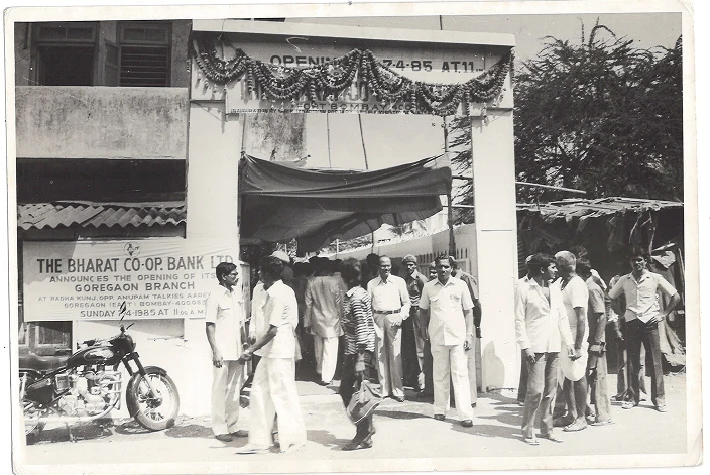
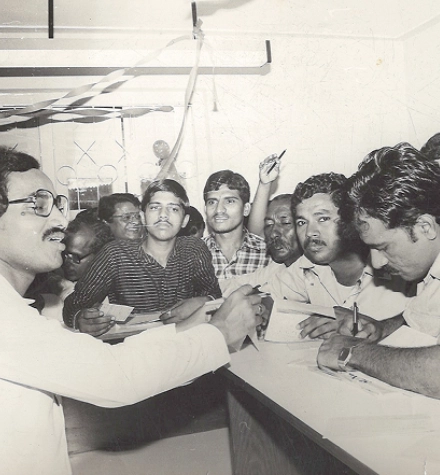
Throughout the 1980s, Bharat Bank expanded its footprint through a steady increase in both its branch network and its customer base. By the early 1990s, the institution had built a solid foundation, achieving a substantial volume of business that reflected its progress from its initial startup phase. The early 1990s marked a shift in the bank’s trajectory. With a renewed focus on expansion and ambition, the institution entered a phase of rapid development.
The pace of expansion was supported by a strong commitment to professional standards. The bank’s reputation was built on two core pillars of Transparent Governance and Personalised Customer Service. As a result of this professional approach, the bank began attracting a diverse range of clients from across the broader public, moving well beyond its original foundations to become a trusted name for the general population.
The 1990s brought formal recognition from India's apex banking regulator. On 22nd April 1996, the Reserve Bank of India conferred Scheduled Bank status upon Bharat Bank, a hallmark of financial soundness and institutional credibility that very few urban co-operative banks achieve. A year later, on 26th September 1997, the bank was registered as a Multi-State Scheduled Co-operative Bank (Registration No. MSCS/CR/71/97), enabling it to carry its services across state boundaries and serve customers in Maharashtra, Karnataka and Gujarat.
The new millennium brought with it a technological revolution in Indian banking, and Bharat Bank was not merely a participant — it was a pioneer. In August 2003, the bank became the first urban co-operative bank in India to implement a Core Banking Solution (CBS). This milestone transformed the customer experience overnight: account holders could now transact from any branch, anywhere, at any time. The CBS also brought Bharat Bank into the RBI's INFINET (Indian Financial Network), enabling participation in the Negotiated Dealing System (NDS), Electronic Clearing System (ECS) and Electronic Fund Transfer (EFT) — infrastructure previously the exclusive domain of larger commercial banks.
As Bharat Bank's customer base grew and their businesses expanded internationally, the need for foreign exchange facilities became apparent. The bank applied to the RBI for an Authorised Dealer licence, and in 2009 — making history once again — Bharat Bank became the youngest co-operative bank ever to receive an AD-Category-I licence from the RBI. Only a handful of co-operative banks hold this distinction, and it empowered the bank's customers to access a full suite of FOREX services, from trade finance to remittances.
The year 2012 brought two celebrations: the launch of the VISA International Debit Card, placing the world's ATMs in every customer's wallet, and the opening of the 50th branch at Bantwal, Mangalore, marking the bank's deep penetration into Karnataka. Two years later, in August 2014, Bharat Bank accomplished the implementations of Finacle — the flagship core banking product from Infosys. By September 2015, the bank had entered Gujarat with four branches in rapid succession and simultaneously opened its 75th branch at Airoli in Navi Mumbai. The momentum continued unabated, and in 2016 the bank achieved a defining landmark: the inauguration of its 100th branch at Khar West, Mumbai — fulfilling an ambitious vision the Board had set years earlier and cementing Bharat Bank's standing as one of the most expansive urban co-operative banks in the country.